Start With a Free Sales Funnel Consultation


A lot of funnels fill with opportunities buyers were never truly committed to.
The seller conducts a discovery call, gets an enthusiastic response, and creates an opportunity. The funnel fills. Activity continues. And then, quietly, nothing happens. The prospect does not say no. They just stop deciding.
The funnel was not the problem. Decision quality was.
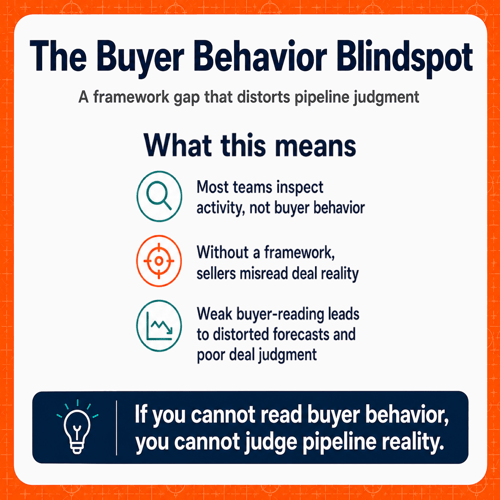 Most sales funnels are designed to track seller motion: the sequence of tasks a rep completes on the way to a proposed close. Meetings are held. Demos delivered. Proposals sent. These are real activities, but they are the wrong proxy for progress. They measure what the seller has done, not what the buyer has decided.
Activity continues, but decision clarity disappears. The pipeline looks full. The forecast looks reasonable. And the quarter ends with a miss that no one saw coming. The warning signs were always there, baked into the structure of the funnel itself.
Funnels fail upstream because the wrong question is being tracked. Instead of asking what the seller has completed, the question should be what the buyer has concluded.
Until the buyer has defined the problem they are trying to solve, identified what a successful outcome looks like, and evaluated their options through that lens, nothing in the funnel reflects reality. It reflects seller optimism.
➤➤ Stages that track seller motion rather than buyer commitment are not a management tool. They are a confidence mechanism. And under pressure, misplaced confidence is expensive. |
When business conditions tighten, whether from economic uncertainty, market disruption, leadership changes, or budget constraints, the most immediate and predictable effect is on buyer behavior. But not in the direction most sales leaders expect.
Buyers do not disappear. They delay. And there is a meaningful difference.
When conditions tighten, buyers delay decisions to reduce personal risk. Approving a major investment during a period of uncertainty is a personal bet. If the decision turns out to be wrong, the individual who made it bears the consequences. So buyers do not stop evaluating; they slow down, expand the committee, require more consensus, and look for more certainty before committing.
This means consensus expands, not contracts. Deals that were being managed with one or two stakeholders suddenly require sign-off from legal, finance, procurement, or the C-suite. Each new stakeholder arrives with their own priorities, concerns, and timelines. The seller a step away from the finish line now finds themselves restarting the qualification process.
Engagement, meanwhile, continues. Emails get answered. Calls are taken. Questions are asked. The seller sees momentum. But while the buyer continues to show interest, interest and urgency are not the same thing. And in difficult conditions the distance between them grows.
Weak qualification does not announce itself in a healthy market. Enough deals close on goodwill and timing that the structural flaws stay hidden. When conditions tighten, that cover disappears. What remains are the habits that were always there:
➤ Sellers confuse conversation with commitment. A prospect who is happy to speak with you has not committed to change. A prospect who agrees your solution addresses a problem has not committed to buying a solution.
Commitment is demonstrated through buyer behavior: the questions they ask, the people they involve, the time they invest, the criteria they define. Most sellers stop short of the evidence required to distinguish real opportunities from polite engagement.
➤ Demos replace diagnosis. When sellers feel pressure to advance a deal, they reach for the demonstration. It is comfortable, it showcases the product, and it feels productive.
But a demo given before a buyer has articulated what needs to change, why the status quo is no longer acceptable, and what a successful outcome would look like is a demo given too early. It answers questions the buyer has not asked yet. And a buyer who has not asked the question rarely remembers the answer.
➤ Deals enter the funnel before buyers understand what needs to change. The standard for entry should not be that the prospect agreed to another conversation. It should be evidence that the buyer recognizes a problem worth solving. Without that evidence, funnels fill with opportunities that look active on paper and are dormant in reality.
Under pressure, that distinction becomes the difference between making the number and missing it.
 The Myth of Funnel Coverage
The conventional response to a shrinking pipeline is to fill it. Add more activity. Work more leads. Get more meetings. The logic seems sound: if the funnel is thin, add volume. If conversion rates are low, compensate with quantity.
This logic is almost always wrong.
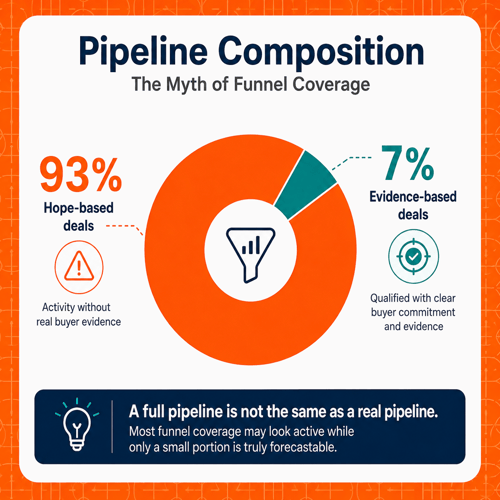
More opportunities does not equal more progress. A funnel filled with poorly qualified opportunities does not produce more closed business; it produces more stalled business. Each poor-quality opportunity requires time, energy, and coaching attention. That attention is finite. Every hour spent managing a deal that was never real is an hour not spent advancing one that is.
False confidence masks structural problems. A funnel that looks full gives leaders, managers, and sellers the psychological sense that something is happening. That sense of activity suppresses the urgency to diagnose the real issue.
The structural problem, including poor qualification criteria, missing buyer commitment, and funnel stages that do not correspond to decisions, stays invisible because the pipeline numbers look adequate.
➤➤ A thin funnel is painful but honest. An inflated funnel full of stalled, hope-based opportunities creates the illusion of progress while real forecast accuracy collapses. Sales leaders who tolerate inflated funnels in good times inherit a forecasting crisis in difficult ones. |
Why Deals Stall at the Same Stages
If you look carefully at where deals stall in your funnel, you will almost certainly find a pattern. It will not be random. Deals do not stall because of bad luck or bad timing; they stall because something specific is missing at a specific point in the buyer's decision process. Stalls are patterns, not accidents.
In research across hundreds of B2B organizations, the most common stall point is not at the beginning or the end of the funnel. It is in the middle, after initial interest has been established and before a formal decision process has begun. This is the stage where sellers assume the relationship is progressing and buyers have moved on to other priorities.
The reason deals stall at the same stages is that each stage corresponds to a buyer decision that must be made before the next stage becomes relevant. When that decision has not been made, or when sellers have not confirmed that it has, the deal does not advance. It gets rescheduled. It gets moved to next quarter. Eventually, it quietly disappears.
Missing buyer decisions at each stage is the structural cause. The seller has completed their task, but the buyer has not completed theirs. They have not:
➤ Aligned their stakeholders on the problem definition
➤ Defined what a successful outcome looks like
➤ Determined the criteria they will use to evaluate options
➤ Established a timeline or decision process
How "no decision" becomes the default outcome is straightforward: it requires no courage.
From the buyer's perspective, making a decision is a risk. Not making a decision is safe. If there is no compelling urgency and no clearly defined cost of inaction, the easiest path is to wait. Sellers who fail to make the cost of inaction visible give buyers a clear path to it.
There is a straightforward test for whether a forecast is based on evidence or hope: look at the close dates. If the close dates were set by the seller, based on their quota deadline or their manager's request rather than derived from a buyer's stated timeline, the forecast is hope-based. If the close dates have been pushed back more than once without a corresponding change in buyer behavior, the forecast is hope-based.
A forecast built on evidence looks different from one built on optimism. The signs of a hope-based forecast include:
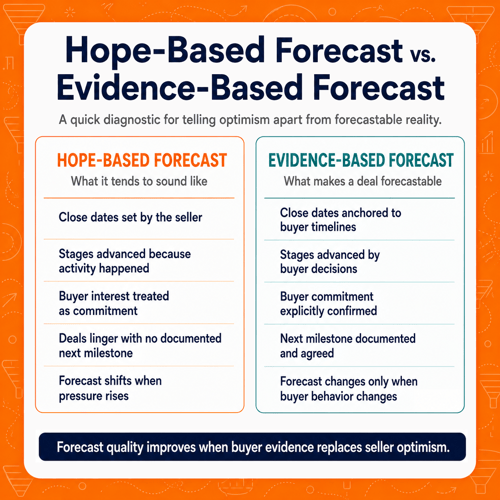 ➤ Close dates set by the seller, not anchored to any buyer-stated timeline
➤ Stage advancement based on seller activities completed, not buyer decisions confirmed
➤ Deals that have been "in proposal" for multiple quarters without documented buyer milestones
➤ Manager pressure producing forecast updates rather than buyer behavior producing them
In stable conditions, some deals close late but close. Relationships carry deals over the finish line. When conditions tighten, buyers have explicit reasons to delay, and the informal momentum that masked weak qualification disappears.

The fix is not a new CRM field or a different stage name. The fix is rethinking what a funnel stage represents.
Stages should represent commitments, not tasks. A stage is not "proposal sent." A stage is "buyer has defined the problem, confirmed the cost of inaction, and requested a formal approach." The difference is not semantic. One is a seller activity. The other is a buyer conclusion. Only buyer conclusions predict close.
What must be true for a deal to advance is the right question for every stage gate in your funnel. Not what did the seller do, but what has the buyer decided, concluded, or committed to. Stage advancement should require evidence, specific and observable buyer behaviors indicating that a real decision has been made. Without that evidence, the stage has not been earned.
➤➤The difference between "we sent a proposal" and "they have defined success criteria and requested our approach" is the difference between hope and evidence. |
How to test reality without slowing sales down is a concern worth addressing directly. Testing reality does not slow sales down; it speeds things up by removing deals that were never going to close and focusing attention on the ones that will. A conversation designed to confirm or challenge a deal's stage takes minutes. Chasing a dead opportunity for three months takes much longer.
One of the most frustrating aspects of sales improvement is the lag between behavioral change and outcome change. Leaders who make the right structural adjustments to their funnel and coaching process often do not see the revenue impact for sixty to ninety days. This lag causes many organizations to abandon the right approach before it produces results.
What changes before pipelines improve are behaviors. Specifically: sellers asking better questions before advancing opportunities; managers requiring buyer evidence before accepting stage changes; teams removing deals that lack specific buyer milestones. These changes are not visible in the revenue line. They are visible in call reviews, pipeline audits, and coaching conversations.
The behaviors that indicate real progress are observable if you look for them:
➤ Sellers who can articulate what the buyer has concluded, not just what the seller has presented, at each stage of the funnel
➤ Managers who are coaching to buyer decision evidence rather than seller activity volume
➤ Forecast discussions that reference specific buyer behaviors rather than seller intuitions
These are leading indicators. Revenue is a lagging one.
Why revenue lags clarity is straightforward: deals in progress were qualified under the old criteria. It takes time for a newly qualified pipeline to reach close. The interim period, when old deals stall and new better-qualified deals are still early, looks worse on paper than the previous reality, even though the underlying trajectory is better. Leaders who understand this can hold the course. Leaders who do not will revert to old behaviors before new ones have time to compound.When a funnel deteriorates, the instinctive managerial response is to inspect more aggressively. More pipeline reviews. More questions. More pressure on close dates and deal status. This response is understandable and almost always counterproductive.
Inspection versus coaching under pressure is the central distinction. Inspection asks what is happening. Coaching asks what should be happening and what needs to change to get there.
Under pressure, most managers default to inspection because it feels active and urgent. But inspection without coaching produces better data and the same outcomes. Coaching produces different behavior, and different behavior is the only path to different results.
What managers should coach when deals stall is not activity. The seller is already doing things. What they need is a better framework for understanding where the buyer is in their decision process. Coach sellers to ask:
➤ What has this buyer specifically concluded about their situation?
➤ What are they still evaluating, and what criteria are they using?
➤ What concern has not yet been addressed?
➤ What would need to be true for them to move forward, and by when?
Why reinforcing behavior matters more than tightening rules is a lesson most organizations learn too late. Rules tell sellers what to do. Behavior reinforcement, which includes coaching to specific examples, reviewing calls for evidence, and recognizing when the right things happen, builds fluency.
Sellers who know the rules know what is expected. Sellers who have been coached to the behaviors can execute under pressure, in ambiguous situations, with real buyers. That capability is the competitive advantage. The rule is just the starting point.
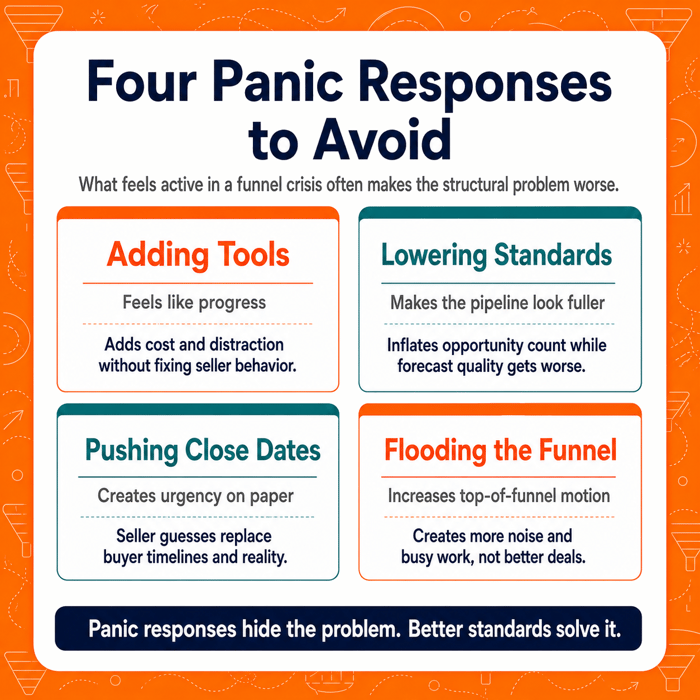
The fastest way to make a funnel problem worse is to react to it. When pipelines shrink, the pressure on leaders to do something is intense. And the things that feel most active tend to be the most damaging. Four responses in particular should be avoided:
➤ Adding tools. A new CRM configuration, a new prospecting platform, a new analytics layer: none of these addresses the underlying issue, which is almost always behavioral and structural. They add cost, distraction, and the illusion of progress without changing what sellers do in conversations with buyers.
➤ Lowering qualification standards. When leaders lower the bar for what constitutes a legitimate opportunity, funnels fill with activity that looks like progress and is not. The problem is not solved. It is hidden, temporarily, at the cost of making the eventual reckoning larger.
➤ Pushing harder on close dates. When managers pressure sellers to commit to close dates that do not have buyer support, sellers learn to say what managers want to hear. Forecast accuracy does not improve. It becomes a parallel fiction maintained by both parties.
➤ Flooding the top of the funnel. More calls to poorly defined prospects with inadequate messaging produce more busy work, not more revenue. Volume without precision amplifies the structural problem rather than solving it.
The good news is that predictability does not require favorable conditions. It requires decision discipline, and decision discipline can be built in any environment.
Tightening decision criteria means raising the evidentiary standard for stage advancement. A deal does not move from stage two to stage three because the seller had a good meeting. It moves because the buyer has specifically articulated the problem they need to solve, confirmed the consequences of not solving it, and agreed to involve the stakeholders necessary for a decision. This standard will initially shrink the pipeline. That is the point. The pipeline that remains will be real.
Coaching for buyer clarity means redirecting the focus of every sales conversation, between managers and sellers and between sellers and buyers, to what the buyer has concluded. Not what the seller presented. Not what the proposal contained. What the buyer concluded.
When sellers are coached to seek and confirm buyer conclusions at every stage, deals that are not real get surfaced earlier, before they consume more resources.
Reducing noise instead of increasing volume is the counterintuitive prescription for a pipeline in crisis. Less activity directed more precisely at better-qualified buyers with stronger messaging produces better results than more activity directed broadly. The best sales organizations do not outwork their competition; they out-qualify them.
If training were the answer to a pipeline crisis, every organization would be thriving. The reality is more complicated: training can be a powerful accelerant of performance improvement, but only when it is applied to the right constraint.
Training does not fix structural pipeline issues by itself. If the funnel stages are wrong, the qualification criteria are too loose, and managers are not coaching to evidence, a training program will teach sellers better behaviors that the system will immediately extinguish. Skills decay without practice.
Practice requires a coaching infrastructure. A coaching infrastructure requires managers who know what to reinforce. Training without those elements is a significant investment in temporary improvement.
How to know if skills, process, or coaching is the constraint requires honest diagnosis:
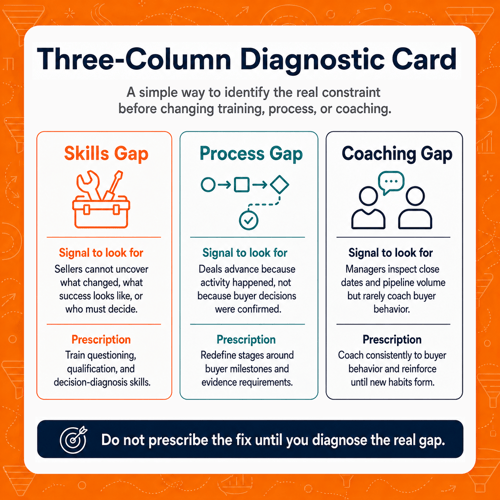
➤ Skills Gap: If sellers genuinely do not have a framework for managing buyer decisions, then skills training is the right investment.
➤ Process Gap: If the funnel structure itself misrepresents reality, process design is the starting point.
➤ Coaching Gap: If sellers know what to do but are not doing it consistently, the gap is in coaching and reinforcement, not in what they were taught.
Most organizations have all three gaps simultaneously, which is why a diagnostic conversation before any training investment is not a nicety but a prerequisite.
One final variable most organizations overlook: timing.
Skills introduced during periods of high disruption do not get practiced. They get ignored. The conditions for learning matter as much as the content of it. When managers have capacity to reinforce and sellers have room to apply new behaviors, training compounds. When they do not, it evaporates.
The most important thing to understand about a funnel under pressure is what the pressure is revealing.
Pressure does not create pipeline problems; it reveals them. The qualification gaps, the hope-based forecasts, the funnel stages tracking seller motion instead of buyer commitment: these existed before conditions tightened. They were tolerated because informal momentum and favorable conditions masked their effect. What feels like a crisis caused by external conditions is almost always a structural problem that external conditions have made impossible to ignore.
Sales pipeline management is, at its core, about decision discipline:
➤ The discipline to qualify by evidence rather than optimism
➤ To coach to buyer behavior rather than seller activity
➤ To stage deals based on what buyers have concluded rather than what sellers have proposed
Predictability returns when behavior and decisions align. Not when the market normalizes. Not when buyers feel more confident. When the internal process, including the qualifications, stage gates, coaching conversations, and reinforcement, corresponds to the external reality of how professional buyers make decisions, forecasts become accurate and pipelines become trustworthy.
To that end, here is where to start:
➤ Diagnose before you prescribe. Identify whether the constraint is skills, process, or coaching capacity before committing to any intervention.
➤ Raise the evidentiary bar for stage advancement. Every stage gate should require documented buyer behavior, not completed seller tasks.
➤ Coach to buyer conclusions, not seller activities. Redirect pipeline conversations from what the seller did to what the buyer has decided.
➤ Remove deals without evidence. A smaller, honest funnel is more valuable than a large, fictional one.
➤ Reinforce the right behaviors before expecting revenue to follow. Observable behavior changes precede measurable outcome changes.
If you are evaluating changes to training, tools, or process right now, this guide should help you ask better questions before making that investment. The question is never what should we add. The question is what is broken, and what is the smallest behavioral change that will make the biggest difference. Start there.