Start With a Free Sales Funnel Consultation


There is no shortage of AI tools promising to make salespeople faster. But speed alone is not the goal. The more important question is whether AI is helping sellers do the right things more consistently.
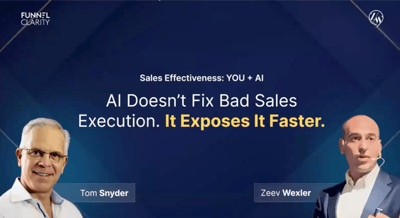 That was the focus of a recent webinar featuring Funnel Clarity Founder Tom Snyder and Zeev Wexler. Their central point was straightforward: AI does not automatically improve sales execution. It amplifies what is already there.
If sellers are following sound sales practices, AI can make those practices easier to execute and scale. If qualification is weak or sales activity is built on assumptions, AI can help a team make those same mistakes much faster. [NOTE: You can catch more of Tom and Zeev sharing sales and AI advice on the Sales Game Changers Podcast AI and Sales Brief.]
Turning back to the webinar itself, Tom and Zeev opened by identifying where most AI sales adoption goes wrong. One of the biggest mistakes sales organizations are making with AI is using it primarily to create more activity: more emails, more messages, more research, more touches.
Zeev challenged that approach directly: AI should not be judged by how much more activity it creates, but by whether it helps sellers make better decisions. Sending 1,000 emails that do not work is not progress. The objective should be better outcomes, not simply more output.
Tom pushed that idea further. If a sales organization does not have a sound methodology underneath the technology, AI can simply make sellers incredibly efficient at doing the wrong thing. The tool itself is not the strategy. What matters is the sales best practice AI is being asked to reinforce.
 AI can provide speed, structure, research support, pattern recognition, and consistency. But the seller still owns judgment, trust, curiosity, context, and value creation. Those are executable skills that can be learned, practiced, and improved.
Tom asked the audience to imagine every seller having a research assistant that never slept, a coach available 24 hours a day, and an analyst that could review CRM notes, evaluate an opportunity, identify missing information, and recommend what the seller should do next.
That is where AI becomes more useful than simply asking it to write another prospecting email.
During the demonstration, Zeev walked through the AI setup while Tom connected its output to the sales methodology, showing how AI can be given specific company information, qualification standards, and operating instructions to support the seller using a repeatable framework.
The framework centered on Funnel Clarity’s Four Qualification Questions©:
The critical word is evidence. A prospect liking a demo is not evidence. Activity and enthusiasm are not evidence. Qualification depends on what the seller has genuinely learned about the buyer and the opportunity.
For the webinar demonstration, Tom and Zeev focused primarily on the first question: What evidence do I have that an opportunity exists?
Before a hypothetical first meeting, AI reviewed account information and identified potential change signals, regulatory pressure, technology issues, competitive pressure, and other factors that might indicate a legitimate reason for the buyer to act. On screen, the output organized those findings into likely signals, open questions, and specific areas the seller should validate during the conversation. It then connected those findings to qualification by helping the seller build a call plan.
After the meeting, the seller could feed the call notes back into the same system. AI could separate validated information from assumptions, flag weak evidence, identify what remained unknown, and suggest areas requiring further exploration.
The value is not that AI replaces the seller's judgment. It reduces the friction involved in applying good sales discipline to every account, call, and opportunity.
One of the strongest examples came when the AI flagged a hypothetical opportunity as single-threaded.
Tom pointed out that sellers naturally gravitate toward the person willing to talk to them. Someone responds, takes the meeting, and seems interested, so the seller continues moving the opportunity forward. The problem is that one enthusiastic contact may not represent the full buying committee.
Without corroboration from other stakeholders, the seller does not know whether that person is driving the decision, gathering information for someone else, or simply exploring an idea. AI did not make the decision for the seller. It surfaced the risk and offered possible next steps to stimulate better thinking.
The point here from the webinar: useful AI should improve judgment, not replace it.
One audience member asked whether a salesperson really needs the amount of information generated in the demonstration before a first call.
Tom's answer was no. The point is not to memorize everything AI produces. It is to have the information available so the seller can quickly identify what matters most. AI removes much of the research friction while leaving the seller in control of how the information is used.
Another audience member asked which AI platform a sales team should use. The answer was similarly practical: the tool matters far less than the setup. What matters is what AI has been told to do, what context it has been given, what counts as valid evidence, and what methodology it is reinforcing.
The lasting lesson from the session was not about a particular AI platform. It was about what happens when powerful technology is paired with disciplined sales practice.
AI can help sellers research accounts, prepare for calls, identify missing evidence, recognize risk, and determine what deserves attention next. But it has to know what good selling looks like. Without that foundation, there is nothing worth scaling.
That same principle applies when deals encounter objections. A pricing concern, competitive objection, timing issue, or late-stage hesitation may appear suddenly, but the underlying problem often began much earlier. The seller may have failed to uncover what changed, understand how the buyer would make the decision, identify the right stakeholders, or build enough evidence to support the opportunity.
In many cases, the objection is exposing a qualification gap that was already there.
Funnel Clarity's Sales Objections Guide: Most Sales Objections Should Never Happen applies that same evidence-based thinking to one of the most persistent problems in the sales process. It explains why objections develop and how stronger qualification can prevent many of them before they need to be overcome.
Download the guide to learn how better qualification can improve deal quality and reduce avoidable objections.