Start With a Free Sales Funnel Consultation


Sales managers face a constant allocation decision. Time, attention, and coaching energy are finite resources. Where those resources are deployed determines whether team performance rises, plateaus, or declines.
One of the most common patterns in sales organizations is over-investment in underperformers.
The instinct is understandable. It is human. It is usually wrong.
Managers want to fix problems. An underperformer represents visible variance. Missed quota, weak funnel metrics, longer cycles. The instinct is to intervene. If the manager can turn that individual around, the entire team improves.
There is also ego involved. Lifting someone from the bottom to the middle feels like leadership. It feels corrective. It feels productive.
Data tells a different story.
If coaching time is disproportionately allocated to low performers, the aggregate return on that time is typically lower than if it were allocated to high performers with additional potential.
Improvement is not evenly distributed across a team. It clusters around potential.
Most managers evaluate performance in isolation. Hitting quota or missing quota becomes the defining metric. That is insufficient.
A more useful lens evaluates two variables simultaneously: performance and potential.
There are four general categories:
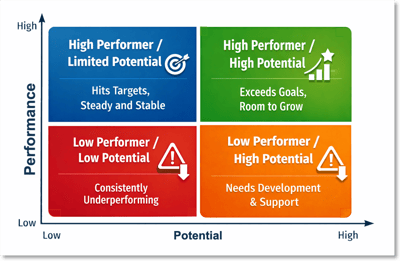 High performance, high potential.
Most managers default to focusing on low performance without considering potential. They devote disproportionate energy to the most visible deficit.
That is a poor return on investment.
Performance improvement should be evaluated by expected gain, not emotional urgency.
If a top performer increases output by 10–15 percent, the revenue impact often exceeds lifting a bottom performer to minimal acceptable levels. Moreover, top performers who are coachable frequently respond more quickly and sustain improvement longer.
Underperformers with low potential consume managerial energy without producing proportional gains. The longer a manager delays a necessary personnel decision in these cases, the more time is withdrawn from high-yield coaching opportunities.
This is not an argument to ignore struggling team members. It is an argument for disciplined allocation of coaching calories.
Over-investment in underperformers often reflects misplaced loyalty.
Managers may feel responsible for the individual. They may believe that with enough effort they can “turn them around.” They may hesitate to move someone off the team because of personal rapport or fear of organizational disruption.
But loyalty to a low-potential underperformer is, in practice, disloyalty to the rest of the team. It diverts attention from those capable of expanding results. It signals tolerance of mediocrity. It compresses overall team performance.
In high-performing organizations, coaching is not charity. It is leverage.
Effective sales managers do three things consistently:
The goal of sales leadership is not to rescue every individual. The goal is to improve aggregate team performance.
That requires allocation discipline.
Managerial time should be treated as a strategic asset. The question is not “Who needs help?” The question is “Where will coaching produce the greatest measurable gain?”
When coaching is applied to high-potential performers, organizations build internal multipliers. When it is absorbed by chronic underperformance, it becomes an expense with diminishing returns.
Sales excellence does not come from rescuing chronic underperformance. It comes from maximizing the performance of high-potential sellers.
If managerial coaching is the primary lever for improving performance, then the coaching approach itself must be disciplined and consultative rather than reactive.
The most relevant resource to deepen that capability is our Consultative Selling Guide. It outlines how sellers, and by extension managers, can guide buyers through decision processes with structure and intent. The same principles apply internally when coaching salespeople: focus on buyer “decision gates”, strategic questioning, and measurable progression.
Strengthening sellers’ consultative discipline equips managers to allocate their coaching calories where it produces the greatest performance gain.
Explore the Consultative Selling Guide to reinforce the coaching behaviors that drive sustained performance improvement.