Start With a Free Sales Funnel Consultation


 Companies are moving fast to adopt AI. Turning that adoption into better execution and measurable results is proving harder.
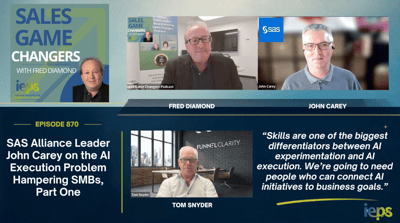
That disconnect was at the center of a recent episode of the Sales Game Changers Podcast, where Funnel Clarity founder Tom Snyder joined host Fred Diamond, from IEPS, and John Carey, SVP of Global Channels at SAS, for the first of a two-part conversation about what is keeping small and midsized businesses from putting AI to work effectively.
The conversation drew on an IDC study commissioned by SAS, alongside John's and Tom's observations from working with customers, partners, and sales organizations. One finding quickly established the problem: fewer than 10% of SMBs have fully embedded AI into their strategy, operations, and decision-making.
As John put it, SMBs don't have an AI adoption problem. They have an AI execution problem.
Businesses certainly aren't ignoring AI. They're buying tools, launching pilots, testing use cases, and encouraging employees to experiment.
John described a "readiness reality gap," where AI ambitions exceed the ability to execute. Companies may have plenty of AI activity without a coordinated strategy connecting it to documented goals and measurable outcomes.
The pressure to move quickly is understandable. Nobody wants to discover that a competitor figured it out first. But moving faster doesn't help if a business hasn't established what AI is supposed to improve.
Tom's warning was simple: AI is an extraordinarily efficient operator of whatever you train it to do. That's good news if the process underneath it is sound. If it isn't, AI can help an organization execute the wrong behaviors faster and at a greater scale.
For sales leaders, that means the starting question shouldn't be which AI application to purchase. Before layering AI onto the sales process, they need to first figure out:
If the underlying process is weak, putting AI on top of it doesn't make it stronger. It just amplifies those weaknesses.
During the episode, Tom also challenged the tendency to treat AI like another piece of software. He suggested thinking about it more like adding an incredibly capable new entity to the organization. It can continuously research, analyze information, support strategy, and coach sellers.
But it needs to be trained. It needs a defined job, reliable context and data, operating guardrails, and a clear standard for what good execution looks like.
That's very different from giving employees an assortment of AI-enabled tools and hoping they collectively improve performance.
"If you don't have those things structured and you're just getting tool after tool after tool, you have great risk of moving backwards," Tom explained.
Data is part of that foundation, too. John noted that when information is spread across disconnected systems, AI has a much harder time delivering consistent, useful insight. Sometimes getting to results faster means slowing down first to establish the processes, data, and objectives AI will work from.
At one point Fred asked whether SMBs have the internal skills necessary to turn AI from an experiment into a genuine force multiplier. Tom said Funnel Clarity has yet to encounter an SMB doing all the groundwork required, but emphasized that this isn't exclusively an SMB problem. Large organizations are struggling with it too.
John identified skills as one of the biggest differences between experimentation and execution. Businesses need people who can connect AI initiatives to business goals, prepare the right data, manage change, and measure whether the technology is producing the intended result.
Knowing how to prompt an LLM is useful. Knowing what good execution looks like is far more important.
AI can give a seller an always-on researcher, analyst, strategist, and coach. The seller still needs the methodology and judgment to know what to do with what it provides.
You can watch the full episode here:
Part One of the 2-part podcast series leaves sales leaders with a clear takeaway: using AI is not the same as executing with it well. Strong results still depend on sound processes, clear business objectives, and sellers who know what good execution looks like.
Part Two takes that conversation further, looking at how companies can move from experimentation to measurable business value and how partners can help guide that process.
Tom has explored the same issue specifically through the lens of sales execution with AI expert Zeev Wexler. Their central point is similar: AI amplifies what is already there. Weak qualification can become faster weak qualification, while a disciplined sales process can become easier and more consistent to execute.
Read our post AI Doesn't Fix Sales Execution. It Exposes It Faster to see how AI can reinforce evidence-based qualification and help sellers apply strong sales discipline more consistently.