Start With a Free Sales Funnel Consultation


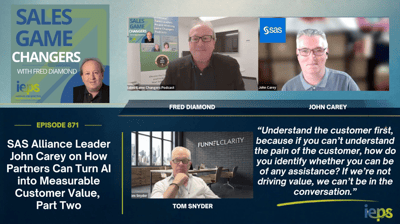 Part One of a recent two-part series on the Sales Game Changers Podcast explored why AI adoption so often falls short of measurable business results. In Part Two, Tom Snyder (Funnel Clarity founder), John Carey (SAS SVP of Global Channels), and host Fred Diamond (IEPS) move from diagnosis to execution. The conversation centers on what companies, sales organizations, and their partners need to do differently if AI is going to create meaningful business value instead of simply more activity.
Drawing on the SAS-commissioned IDC research, John highlighted four areas organizations need to address: planning, building, enabling, and executing.
But first, companies need to answer a more fundamental question: What problem are we trying to solve?
AI can do a lot of things. That is part of the problem.
John argued that companies should narrow their focus to one meaningful business challenge, confirm the necessary data is available, define measurable outcomes, prove value, and only then scale.
Tom contrasted that with the “wild, wild west” of AI implementation he sees in many organizations. Sellers are experimenting with tools for emails, prospecting, research, and countless other tasks, often without a larger plan governing how any of it should work.
The better questions for sales leaders are:
Without those answers, AI may create efficiency without creating value.
Before AI can improve a sales process, the organization needs confidence that the process itself is sound.
Sales organizations have no shortage of methodologies. The question is whether those methodologies reflect research-based best practices and whether sellers can consistently execute them.
As Tom explained, AI can make that execution dramatically easier, or create enormous efficiency around the wrong behaviors.
First establish the process. Then prove AI is improving it. Scale comes after there is evidence of value.
John defined AI-ready data in three words: accessible, reliable, and trusted.
Fragmented or questionable data limits AI's ability to produce consistent insights and can undermine confidence in the system itself.
That makes data readiness part of AI readiness. Before organizations rely on AI to inform better decisions, they need to trust the information feeding those decisions.
When Fred asked what partners and sellers need to become as AI changes the selling environment, Tom's answer wasn't “AI experts.” It was something much closer to decision coaches.
Tom pointed to three ways sellers create value before a customer buys anything: helping customers recognize a problem or its true magnitude, discover a solution they hadn't considered, or access expertise from the seller's organization that helps them make a better decision.
AI can make sellers far better equipped to do those things by processing information, identifying patterns, and helping them enter customer conversations with greater context. But the seller still has to recognize what matters and create value from that information.
John reinforced the point from the partner side. Partners don't need to know everything about AI architecture. Their differentiated value comes from understanding the customer well enough to identify the problem worth solving, the outcome worth measuring, and the proof point that earns the right to scale. SAS can help partners build the technical capabilities needed to support that work.
John described the goal as “human-in-the-loop decision-making.” The objective is to combine human context, expertise, and judgment with the processing power AI provides. For salespeople, partners, and channel managers, that leads back to the same job: create value before asking for the sale.
Tom argued that channel managers should approach partners the same way. Their role isn't simply to ask what has sold and when the next deal will close. It is to help partners become more successful at serving their customers.
AI can accelerate that capability when the foundation underneath it is right.
Across both episodes, Tom, John, and Fred move from the problem to the path forward. Part One examines why SMBs are adopting AI without getting the results they expected. Part Two focuses on what needs to change.
Together, the episodes make the distinction clear: AI experimentation starts with tools. AI execution starts with a meaningful business problem, trusted data, a disciplined process, human judgment, and a measurable outcome.