Start With a Free Sales Funnel Consultation


We had a client with genuinely disruptive software for banks and credit unions. Not "innovative" in the marketing sense where everything claims to be groundbreaking. Actually innovative: an unexpected solution to a problem the industry had accepted as impossible to change, like the law of gravity.
They kept hiring sales leaders with impressive resumes. People who'd crushed quota in competitive markets, who'd built high-performing teams, who came with glowing references. Six months later, they'd let them go and start the search again. This cycle repeated four times before they figured out what was wrong.
The problem wasn't the people. It was that selling innovation requires fundamentally different skills than selling in mature markets, and almost no one understands the distinction.
In mature markets, buyers know the problem exists. They understand the solution category. They've bought similar products before. Your job as a seller is differentiation: proving your solution is better than the competitor's under the buyer's definition of success. It's about building a better mousetrap.
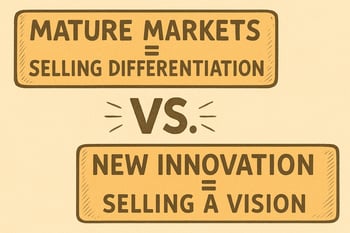 In innovative markets, buyers don't have a mental framework for what you're offering. They've never encountered this type of solution. Many don't even realize the problem is solvable. Your first job isn't differentiation. It's creating a vision of an outcome they never anticipated was possible.
If you approach an innovation sale with mature market tactics, you'll hear this response constantly: "Wow, that's really interesting. Best of luck to you. We're not buying one."
Picture rolling into a town where everyone rides horses. You're selling automobiles. You start explaining features: goes faster, travels further, doesn't need a blacksmith, doesn't need to be fed, doesn't get hurt.
They look at you like you're crazy. They like their horses. They're comfortable buying horses. They've done it their whole lives. They know how to pick a good one. This automobile thing? They have no idea why they'd want it. And don't even get them started on sitting on top of a canister of explosive liquid.
You can talk about horsepower and fuel efficiency all day. Until they can articulate back to you why getting rid of their horse would produce benefits they care about, you won't make the sale.
That's the innovation challenge. You have to help buyers create a new mental file folder, a place to conceptualize an outcome they thought was unattainable.
One of our clients built an AI engine for processing loans to small and mid-size businesses based on cashflow analysis. If you know anything about banks and credit unions, they're cautious about embracing anything new.
Traditional lending to small businesses requires weeks of work. The lender spoon-feeds the business owner through creating reasonable financial statements, then analyzes those statements for risk-return. It's expensive. So expensive that most banks don't even bother with small business lending, despite the fact that small and mid-size businesses vastly outnumber large enterprises in every market.
Our client's AI engine determines creditworthiness in less than ten minutes. Ten minutes versus three to four weeks. The efficiency gain is obvious.
But banks kept slotting them into existing categories: "Oh, I get it. You're just like [other SaaS lending platform]." Once that happens, the battle is lost. They're evaluating you as a slightly different version of something familiar, not as a fundamentally new approach.
When selling innovation, you cannot lead with differentiation. You have to create the vision first.
What does that mean practically? It means your discovery conversations must help buyers articulate the benefits of solving a problem they've accepted as unsolvable. You're not asking, "Which vendor are you considering?" You're asking, "What would it mean for your business if you could eliminate this three-week process entirely?"
If they can't articulate those benefits back to you in their own words, you're not ready to demonstrate your solution. You're still building a vision.
This is why hiring mature market sellers for innovation roles fails so consistently. They jump to product demos. They focus on features and competitive advantages. They're doing exactly what worked in their previous role, but it's the wrong play entirely.
Ask yourself: Do our buyers understand the problem category and know how to evaluate solutions?
If yes, you're in a mature market. Focus on differentiation, competitive positioning, and proof points.
If no, you're selling innovation. Focus on creating vision, helping buyers conceptualize new outcomes, and building the business case for solving what they thought was unsolvable.
The sales methodology that works in one environment actively undermines success in the other. And most sales training doesn't make this distinction at all.
Before investing in sales training, diagnose which market you're actually operating in. Then ask vendors how their approach adapts to that reality.
If they claim "our methodology works everywhere," that's a red flag. Selling innovation and selling in mature markets both require core consultative skills, but those skills get applied in fundamentally different ways.
Not sure how to evaluate whether a sales training vendor understands your market reality? Our guide, Minimize Risk, Maximize Results: The 2026 Sales Training Selection Guide, walks through exactly what questions to ask and what red flags to avoid.