Start With a Free Sales Funnel Consultation


There are moments in business when a new tool simply makes work faster. And there are moments when it changes the standard altogether. AI is such a tool.
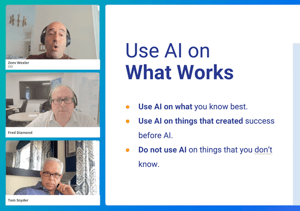 In a recent IEPS webinar hosted by Fred Diamond, Viacry CEO Zeev Wexler and Funnel Clarity Founder Tom Snyder explored what Tom described as one of the rarest inflection points in business history, by those that study human progress it is referred to as a Medici connection. Such as the case with the current convergence of sales science and artificial intelligence.
The webinar, entitled You + AI Is the New Sales Standard: Qualify Better with AI, was not a basic "AI in sales" discussion. It was a discussion about using AI to think better, qualify better, and execute better. This article provides a quick recap.
Let’s begin with a premise that can sound bold if you have not seen the research: sales is a science.
At Funnel Clarity, our work is built on analysis of thousands of real sales funnels and decision processes. We do not rely on opinion, inspiration, or charisma. We rely on observable patterns in how B-2-B buyers actually make decisions.
During the webinar, Tom shared four qualification questions that should govern every opportunity from first contact to close:
The operative word in each question is evidence. The key is that these questions should be guiding qualification throughout the sales process. Further these are questions a seller needs to reflect upon before and after each sales task.
Most sales funnels are built on enthusiasm, not evidence. We have studied more than 1,700 corporate funnels. Roughly 90% of what sits in them does not meet an evidence standard. It meets a “hope standard.”
AI tools make it far more practical to maintain discipline around evidence. It does not replace judgment. It enhances your ability to continually gather, organize, and test evidence.
Zeev, who has over 15 years of AI leadership experience, framed AI for listeners as a multiplier, not a threat. He pointed out that AI can outperform humans in four key areas:
AI can process vast data sets in seconds. It can structure research that used to take days. It can analyze trends in emails, notes, and reports that no individual seller could synthesize alone.
But AI cannot:
The seller remains the decision counselor.
What AI provides is leverage. It frees you from manual tasks so you can focus on what actually moves deals forward: strategic conversations and clearer qualification.
Consider the first qualification question: What evidence do I have that an opportunity exists?
AI can:
But it is still your responsibility as a seller to verify that evidence with the decision maker.
This pattern holds across all four questions.
AI can support your preparation. It can help you draft structured plans. It can analyze competitive positioning. It can flag risk factors. It can help you refine your strategy.
But it cannot make the call for you. Your expertise remains central. AI sharpens it.
During the webinar, Zeev demonstrated how tools like Microsoft Copilot can be configured to support disciplined selling. Two principles stood out:
First, prompting is a skill. If you tell AI to “write an email,” you will receive a generic email. If you instruct it to act as a seasoned B2B sales assistant, define the audience, clarify the goal, specify required elements, define tone, and impose guardrails, the output changes dramatically.
Second, structure compounds advantage.
Notebooks inside Copilot allow sellers to create dedicated environments for specific use cases. Imagine building:
Now imagine those notebooks continuously refined over time. That is not automation for automation’s sake. That is disciplined sales thinking at scale.
In the history of business, there are rare moments when two domains intersect and permanently reshape performance standards. PowerPoint altered how we present. The smartphone altered how we communicate. The internet altered how we research.
The integration of AI with disciplined sales science alters how we prepare, qualify, and execute.
And unlike previous shifts, adoption cycles are measured in weeks, not years. The question is not whether AI will be used in selling. It will. The question is whether it will be used in a disciplined, evidence-based way or in a volume-driven, undifferentiated way.
One path increases noise. The other increases precision.
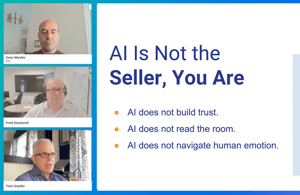 If you take one concept from the webinar, let it be this: AI is not the seller. You are.
But if you combine structured sales science with AI’s capacity for speed, analysis, and scale, you dramatically increase your ability to:
This is not about sending 1,000 emails faster. It is about becoming the decision counselor in every opportunity you pursue. The Medici connection is here. The only real decision is whether you engage with it early, or attempt to catch up later.
If you would like to see the full IEPS discussion and demonstration, you can watch the webinar recording HERE.
And if the intersection of disciplined qualification and AI raised questions about pipeline reliability, the next logical step is addressing forecast accuracy directly with our eBook Sales Forecasting Fixed: Take the Guesswork Out Of Revenue Forecasts.