Start With a Free Sales Funnel Consultation


When the funnel looks weak, many organizations go shopping. They start looking for a new sales engagement platform, a more robust enablement tool, or perhaps a shiny new AI assistant.
The logic is understandable. If the funnel is not producing enough qualified opportunities, if deals are stalling, or if forecasts are unreliable, technology seems like a concrete fix.
But that is often where the mistake begins.
A funnel problem is rarely solved by adding another tool to the stack. Tools can make a strong sales process easier to execute. They can make good behavior more efficient. They can make useful data more visible.
They do not replace the behaviors and management discipline required to create buyer progress.
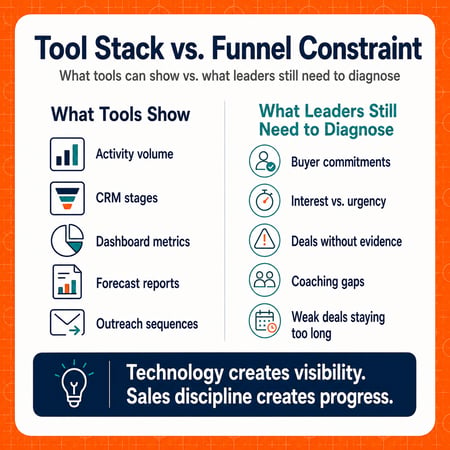
Sales technology can organize activity, automate reminders, capture contact data, sequence outreach, summarize calls, route leads, and display sophisticated reports.
But better reporting is not the same as better selling.
CRM systems and sales platforms often produce streams of data, charts, dashboards, and metrics that give leaders the impression they are better equipped to manage sales performance. In reality, they may only be better equipped to measure activity.
That difference matters:
The technology may make the problem easier to see. It may also make the problem look more organized than it is.
 Sales leaders are drawn to tools because they want visibility. They want to know what sellers are doing, where deals stand, and which opportunities are likely to close.
That is reasonable. But visibility depends on the quality of the information entering the system.
If the data going in is late, incomplete, biased, or based on seller optimism, the dashboard will not reveal reality. It will produce a cleaner-looking version of the same bad assumptions.
A CRM may show a late-stage opportunity. But what buyer behavior supports that stage?
A sales engagement platform may show high activity. But what percentage of that activity is creating real conversations?
A dashboard may show healthy funnel coverage. But how much of that funnel is based on buyer commitments rather than seller hope?
Without a sales framework underneath the technology, reports can become beautifully formatted misinformation.
Most funnel problems begin before technology enters the picture.
They begin with sellers who cannot distinguish curiosity from commitment. Managers who reward activity volume instead of buyer movement. Sales stages built around seller tasks instead of buyer decisions. Teams that do not know when an opportunity should be advanced, slowed down, or removed.
Common symptoms include:
A new tool may record these problems. It may even accelerate them. But it will not correct them unless the underlying behavior changes.
Sales tools are useful when they support the work sellers need to do to create buyer progress.
That means the technology should make it easier to:
When tools are implemented without that discipline, they often become another layer of work for sellers. Sellers enter data because leadership requires it, not because it helps them sell. Managers get reports, but not better insight. Leaders see activity, but not necessarily progress.
That is why the complaint sounds familiar: “The team is using the system, but the funnel is still not improving.”
It should not be surprising. Technology can enable performance. It does not substitute for skill, process, or coaching.
Before adding another sales platform, leaders should ask a more basic question: What is the real constraint in the funnel?
Ask questions like:
Those questions are less exciting than a new platform demo, but they are more likely to reveal the truth.
A funnel problem does not become a technology problem simply because technology is involved. In many cases, the tool stack is where weak process, poor qualification, and inconsistent coaching become visible.
Sales leaders do not need to reject technology. They need to put it in the right order. The principle is straightforward:
➤ Define what buyer progress looks like
➤ Build the sales process around it
➤ Coach sellers to execute it
➤ Use technology to support and measure that behavior
When deals stall and funnel pressure rises, the temptation is to add another fix. But if the real problem is behavioral, structural, or managerial, the next tool may only help you inspect the problem faster.
For a practical framework on diagnosing what is really causing funnel pressure, download our new, Sales Funnel Management Under Pressure. It helps sales leaders evaluate whether the issue is training, process, coaching, or tool misuse before investing in another surface-level fix.