Start With a Free Sales Funnel Consultation


Here's a pattern we've watched repeat across hundreds of B2B organizations: A company promotes its top seller to sales manager. That new manager does what they're good at: selling. The team becomes a support system. Deals get opened, the manager sweeps in to close them, then hands everything off to implementation. Six months later, nothing has changed except now you have an overpaid salesperson with a fancy title.
No one learns. Performance doesn't improve. The team stays stuck.
The problem isn't the manager's intention or work ethic. It's that excelling at sales doesn't automatically translate into coaching capability. Yet most organizations promote top performers into management roles without ever teaching them how to actually manage and coach.
In a well-functioning sales organization, the primary job of a sales manager is to drive performance. Not update CRM fields. Not run fancy reports. Not attend endless meetings. Their role is to drive performance.
But if they don't know how to do that, if no one ever taught them the mechanics of coaching, simply insisting they "coach the team" is absurd. It's like hiring someone to coach a sport they've never played and aren't familiar with.
We had a client we'll call Mike. He was the ultimate seller. Not just number one in his company, but so far ahead of number two it was almost embarrassing. When he reluctantly agreed to become a sales manager, he did exactly what most promoted sellers do: kept selling. His team of underperformers, none above 38% of quota the previous year, remained underperformers.
After we trained his team, Mike called with an honest question: "I'm all about this coaching idea. How do I actually do that?"
We taught Mike and his peers a framework that breaks sales management into four clear functions:
INSPECT. You don't need a dozen metrics. Three or four ratios tell you where to pay attention and which individuals need assistance.
CELEBRATE. Don't just celebrate closed deals. Celebrate behaviors where a salesperson did the right thing and it worked. Then socialize that success across the team.
COACH. Help someone get better at something they already know how to do but aren't executing consistently.
TRAIN. Teach someone something they need to know but don't yet have the knowledge to apply.
This taxonomy gives managers a clear path: who to coach, when to coach, and how to coach. It removes the vague directive of "just go do coaching" and replaces it with a structured approach.
Six months after implementing this framework and coaching the coaches, five of six sellers on Mike's team were on pace to exceed quota. And Mike's team wasn't even the best-performing group.
Coaching doesn't happen through intention. It happens through scheduled, protected calendar time.
Research consistently shows that 30 minutes of coaching twice a month produces measurable performance improvement. It doesn't require massive time investment. It requires consistency.
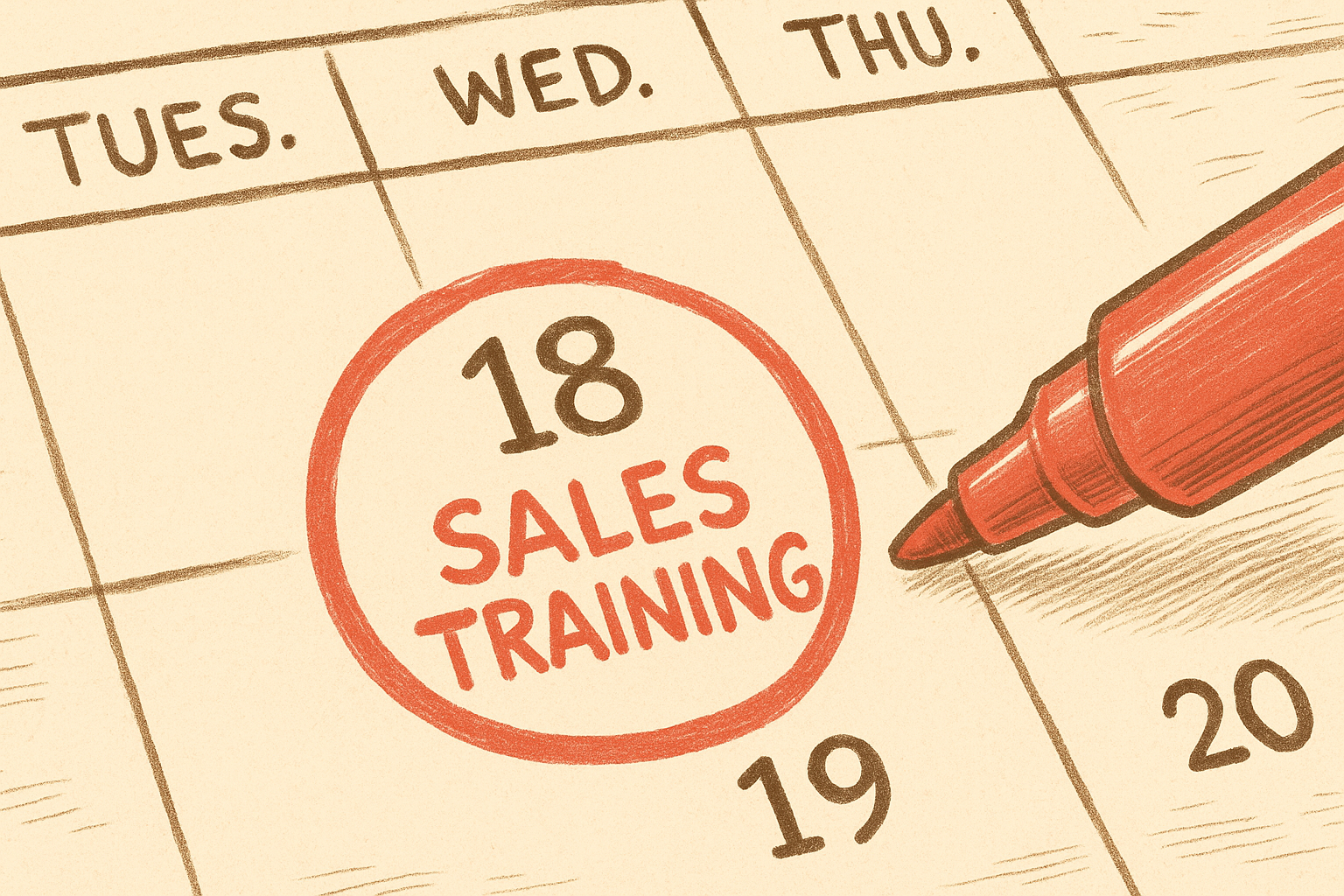 Set your cadence (every Tuesday morning, three times a week, whatever works) and put it on the calendar. Then protect it like you'd protect a customer meeting. Because here's the truth: There aren't many things more important than coaching. Customer emergencies qualify. Most other "urgent" requests don't.
Things will interrupt your cadence. But set the rules of interruption ahead of time, and make the bar high.
Every dollar spent on sales training produces a return only if someone reinforces what was learned. Without coaching, even the best training content fades within two weeks as sellers revert to old habits under daily pressure.
Sales managers are the key to ROI on training investment. They're the force multipliers who turn knowledge into fluency, fluency into habit, and habit into measurable performance gains.
If managers can't provide that coaching due to capacity constraints, skill gaps, or organizational structure, find another way. Sales enablement teams can step in. External coaching partners can fill the gap. But someone needs to do it.
The smallest behavior change, coached consistently, produces the largest measurable outcome. That's not motivational rhetoric. It's how adult learning and behavior-change actually work.
Mike's transformation from player-coach to actual coach didn't happen because he attended a workshop. It happened because someone taught him the principles, gave him the techniques, and equipped him with the resources to coach deliberately.
Performance improves when organizations treat coaching as a core competency, not an assumed skill that automatically accompanies a promotion.
Want to build coaching capability into your sales organization? Our new guide, Minimize Risk, Maximize Results: The 2026 Sales Training Selection Guide, explains exactly how to evaluate vendors on their reinforcement systems and manager enablement, before you write a check.