Start With a Free Sales Funnel Consultation


When sales performance starts to slip, leaders often ask the same question first: What do we need to fix?
The answer is rarely obvious. A team may need better skills, a clearer sales process, or stronger coaching from managers, and often some combination of all three. But treating every execution issue as a training problem, or every pipeline issue as a process problem, wastes time, money, and energy.
The better question to ask is: What specific constraint is limiting the team's results?
Sales performance is shaped by what sellers understand, how consistently they apply it, and whether the organizational system allows managers to inspect and reward the right behaviors. If leaders diagnose the wrong constraint, the remedy will feel active but produce little to no change.
Training is required when sellers do not possess the basic knowledge of what they are supposed to be doing. A seller may be working exceptionally hard, but they fundamentally do not understand how to execute the moments that matter most.
In my experience, training is necessary when a team is:
When a team lacks this foundational understanding, coaching alone will fail. Coaching assumes the person already understands what good execution looks like. Without that shared definition of performance, a manager trying to coach is simply putting the cart before the horse.
The goal of training should be highly targeted. Leaders should look to train teams in the specific areas that require the least amount of learning that will produce the greatest result in the shortest time.
Coaching is required when sellers thoroughly understand what to do, but they are not doing it well enough or consistently enough. At its simplest, training builds basic understanding, while coaching improves execution.
We see this in any performing discipline, whether it is sports, music, chess, or sales. If a person understands the mechanics of what they are supposed to do but they are not getting the full result, they do not need another classroom lecture. They need a coach.
This distinction is where the vast majority of sales investments fail. Data shows that only 3-5% of people who go through sales training can move straight from the classroom into successfully changing their behavior.
The other 95-97% of participants face a predictable human hurdle:
This behavior gap is why coaching carries the entire ROI of your training initiatives. Without coaching, training is just an expensive event that fails to change behavior. With coaching, it becomes a mechanism that carries your team to a measurable result.
Sometimes, the constraint is neither the seller’s knowledge nor the manager's willingness to coach. The breakdown happens because the sales process itself is misaligned with reality.
Process work is required when the system encourages salespeople to produce beautiful reports of misinformation. If a sales process defines pipeline stages entirely by seller activity, such as demo completed, proposal sent, or contract delivered, rather than buyer commitment milestones, the process is broken.
Without proper process work, you force salespeople into a broken loop:
Process work fixes the system so that training and coaching can actually scale. It ensures the organization is measuring and inspecting the interim decisions and commitments the buyer is demonstrating, rather than just the actions the seller is taking.
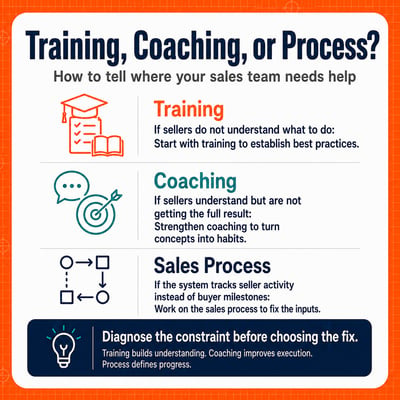 To unblock your sales function, the diagnostic framework is straightforward: identify whether the constraint is knowledge, execution, or the system itself.
Before investing in another workshop, applying backward pressure to the pipeline, or asking managers to inspect harder, stop and determine where the true constraint lives.
The challenge is that these constraints are not always easy to see from inside the sales organization. Activity can look like progress. A full funnel can look like confidence. A late-stage opportunity can look healthy right up until the buyer stops responding.
That is where a more structured assessment helps. Our Sales Funnel Diagnostic gives sales leaders a quick way to pressure-test the health of their funnel and identify where weak spots may be hiding. The diagnostic is a practical place to start before deciding where to invest next.