Start With a Free Sales Funnel Consultation


When the pipeline shrinks, the reflex is predictable. More calls. More emails. More demos. More follow-up. More pressure on sellers to do more and move faster.
Activity matters. Sellers need to prospect, run meetings, ask questions, and keep conversations moving. But watching activity and coaching are not the same thing. When leaders treat them as if they are, the team gets busier without necessarily getting better.
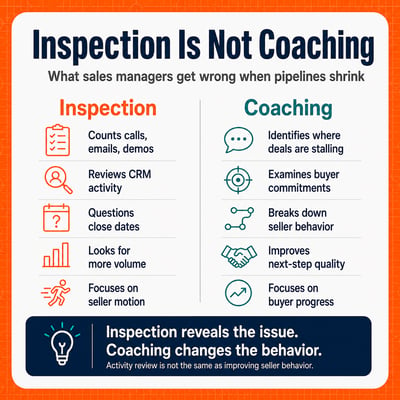
Checking activity tells you what happened. Coaching helps someone do better next time.
That difference matters most when the funnel is under pressure.
When revenue slows, demanding more feels responsible. More outreach is measurable. More meetings are visible. A fuller CRM can make the team look productive. But more activity does not automatically create more opportunity.
The real measure is not how much activity happened, but how much of it produced buyer progress. Progress is determined by the buyer, not the seller.
A few signals that matter:
If not, the activity may be real, but the opportunity may not be.
Inspection still matters. Sales managers should know who is prospecting, who is creating conversations, who is advancing buyers, and who is letting weak opportunities linger.
But inspection is diagnostic. It is not developmental.
A manager who says, “You need more activity,” has identified a possible symptom. The next step is understanding what is happening inside that activity.
Different sellers may have different problems:
Those issues require different coaching.
This is where inspection becomes useful. It should help the manager identify where, who, and what to coach.
If a seller is generating strong buyer progress, study what they are doing well. If another is producing little progress despite significant effort, break down the work. Is the problem targeting, message quality, cadence, call execution, qualification, or confidence?
That is coaching. It moves from general pressure to specific improvement.
A seller can complete every task and still fail to create a real opportunity. They can make the call, send the email, run the demo, deliver the proposal, and update the CRM. None of that proves the buyer is moving.
The evidence that matters is buyer behavior:
Without those signals, a funnel can fill with hopeful interpretations:
Under pressure, this gets worse. Sellers do not want to remove opportunities when coverage is thin. Managers do not want the number to shrink further. So everyone keeps staring at a funnel that looks healthier than it is.
Inspection should challenge that false confidence. Coaching should help sellers replace it with better judgment.
 Telling a seller to “create more urgency” is not coaching.
Neither is:
Those may be valid goals, but they are not specific enough to change behavior.
Useful coaching breaks performance into observable actions. It helps the seller understand what to do differently, why it matters, and how to recognize whether it worked.
For example, a manager might coach a seller to stop treating interest as urgency. A prospect may like the product, ask smart questions, and attend the demo. That feels encouraging. But unless the buyer can explain why the current state is no longer sufficient and what happens if nothing changes, the seller may be managing curiosity, not opportunity.
That is a coaching moment.
The manager’s role is to help the seller see the difference before the opportunity becomes another stalled deal.
When pipelines shrink, leaders do not need less discipline. They need better discipline.
The question should not be: “Are our sellers doing enough?”
The question should be: “Are the activities we are inspecting creating buyer progress?”
If the answer is yes, study the pattern and coach the team toward it. If the answer is no, increasing activity may only make the problem harder to see.
Inspection can reveal the issue. Coaching changes the behavior.
That distinction is critical when deals stall, forecasts soften, and leaders feel pressure to act quickly. Funnel problems rarely get solved by demanding more motion. They get solved by understanding which actions create real buyer movement and helping sellers repeat those actions more consistently.
For a deeper framework on what to do when deals stall and conditions tighten, download our new guide, Sales Funnel Management Under Pressure. It gives sales leaders a practical way to evaluate whether the real issue is activity, process, training, or coaching, so they can fix the constraint instead of adding more pressure to an already strained funnel.