Start With a Free Sales Funnel Consultation


A full sales funnel can be reassuring. It gives leaders something to inspect, something to forecast from, and something to point to when questions come up about future revenue.
But a full funnel is not the same as a healthy funnel.
Many sales organizations have plenty of opportunities in the CRM, plenty of recorded activity, and plenty of sellers who can explain what happened on the last call. The harder question is whether those opportunities are real, qualified, and moving forward for the right reasons.
A funnel may look active on the surface while hiding weak qualification, vague buyer commitment, inconsistent coaching, or opportunities that have moved stages without enough evidence.
Most sales leaders can see more than ever: calls logged, emails sent, demos completed, proposals delivered, and next steps entered into the CRM.
That information matters, but it does not always answer the most important question: What has the buyer decided?
This is where funnels create false confidence. The CRM shows motion. The seller has activity to report. But movement inside a sales process does not always mean movement inside the buyer's organization.
Healthy funnels are built on evidence of buyer commitment, not just evidence of seller effort.
One of the most common funnel problems is not that sellers fail to qualify. It is that they qualify too loosely, too quickly, or too late.
A prospect is interested, so the opportunity is created. The conversation goes well, so it advances. The buyer asks for information, so the deal looks promising. But interest is not the same as intent.
A buyer can be curious without being committed. They can take a meeting without owning the problem. They can request a demo without having budget, urgency, authority, or internal alignment. They can appreciate the solution without having a compelling reason to change.
When those distinctions are not addressed early, the funnel absorbs opportunities that were never as strong as they appeared. They sit in the pipeline, consume seller attention, and make forecasts look better than they are. Then, when the close date approaches, they stall, slip, or disappear.
By then, the issue looks like a late-stage sales problem. In reality, it may have started much earlier.
➤➤ See Where Your Funnel Stands - Take a Free Self Diagnostic!
No sales funnel is perfect. Every team will have stalled deals, imperfect data, and opportunities that do not convert. The question is whether leaders can see those risks early enough to respond well.
A healthy funnel helps leaders assess whether sellers are advancing opportunities based on buyer actions or internal sales milestones. It reveals whether managers are coaching to evidence or simply reviewing activity. It also makes it easier to tell whether close dates are based on buyer timelines or seller optimism.
These questions matter because funnel problems are rarely isolated. One weak opportunity may not mean much. A pattern of weak next steps, unclear buying criteria, vague urgency, or inflated pipeline tells a different story.
That is why sales leaders need more than a dashboard. They need a clear way to assess how the funnel is functioning.
When a funnel starts to feel uncertain, the instinct is often to push harder: more calls, more pipeline reviews, more prospecting, more urgency.
That response is understandable, but it can make the problem worse:
A funnel under pressure does not need panic. It needs diagnosis.
Before changing the sales process, adding tools, or pushing sellers for more volume, leaders need to understand where the funnel is strong and where it may be creating risk. When those fundamentals are clear, leaders can make better decisions. When they are unclear, every response becomes a guess.
Sales leaders do not need another complicated exercise to begin assessing funnel health. They need a practical way to step back and identify where their funnel may be working well and where potential gaps are forming.
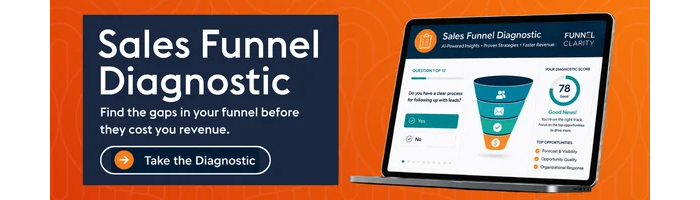
That is the purpose of our new Sales Funnel Diagnostic. It is self-administered and designed to help managers uncover possible gaps in their sales funnel, as well as areas where the team may already be excelling. If your funnel looks active but still leaves you questioning opportunity quality, forecast confidence, or seller consistency, take the diagnostic (no email required!) to see where your funnel is strong, where it may be exposed, and what your team may need to address next.