Start With a Free Sales Funnel Consultation


Bringing an entire sales organization together for a sales kickoff is expensive. There are flights, hotels, meeting spaces, food, entertainment, and all the logistics required to make it happen.
Then there is the cost that doesn't appear on an event budget: taking every salesperson out of the field for three or four days.
That doesn't mean companies should stop holding in-person SKOs. Far from it. For remote and distributed sales teams, getting people into the same room can create opportunities for collaboration, learning, and team cohesion that are difficult to reproduce virtually.
But if a company is going to make the investment, the agenda really needs to justify it.
If most of what happens at your SKO could have been accomplished on Zoom, why did everyone need to be there?
That question should influence nearly every decision sales leaders make when planning the event.
An SKO can serve several purposes. It might celebrate the previous year's accomplishments, introduce a new strategy or product, develop skills, challenge the organization, strengthen relationships, or simply bring a distributed team together.
Any of those can be legitimate.
The problem comes when companies begin planning the agenda before deciding what success should look like.
Don’t select a speaker only because the name is recognizable or their biography is impressive. Ask what the audience will take away, whether the speaker can engage a live room, and what sellers will do differently because that person spoke. Challenge prospective speakers as to how what they offer can be sustained post-SKO.
If learning is the goal, what should sellers know or be able to do afterward? If the purpose is to challenge the organization, what thinking or behavior needs to change? If team cohesion is the priority, what kind of interaction will create it?
There should be a reason for taking everyone away from customers and prospects for three or four days.
Once the objective is clear, every agenda item can be subjected to a simple test: Does this need to happen while everyone is physically together?
Consider the traditional parade of executive PowerPoints. Senior leaders present company updates. Department heads review priorities. Someone walks through last year's numbers. Another person introduces this year's targets.
Some of that information may be important. But important doesn't necessarily mean it belongs at your SKO.
If the same information could be communicated effectively through Zoom, a webinar, a regular sales meeting, or even an email, using valuable face-to-face time to deliver it deserves scrutiny.
That doesn't mean eliminating presentations entirely. It means recognizing what is scarce.
Information isn't scarce. Having the entire sales organization in the same place at the same time is.
Sales professionals spend plenty of their working lives sitting through meetings. Bringing them across the country to sit through longer ones isn't making particularly good use of the investment.
An in-person SKO creates opportunities for activities that are much harder to replicate virtually: small-group problem solving, paired exercises, sales practice, competitions, product experiences, facilitated discussions, and shared challenges.
We have seen organizations take this principle beyond traditional sales exercises. At one SKO, participants broke into teams and built bicycles and skateboards for local foster children.
The takeaway isn't that every company needs to turn its SKO into a philanthropic event. It is that the activity gave people a reason to interact, collaborate, move around, and accomplish something together.
That is fundamentally different from watching another slide deck.
The same standard should apply when selecting outside speakers.
Sales teams often arrive at kickoff exhausted from closing the previous year. There is nothing wrong with recharging their batteries or creating some excitement about what comes next.
But motivation alone has a short shelf life.
Purely motivational content is the “cotton candy” of an SKO. It may feel good at the moment, but sales professionals need more than a temporary boost.
Before hiring a speaker, decide what role that person needs to play. Is the objective to motivate? Inform? Challenge assumptions? Teach something sellers can apply?
A strong speaker can still be entertaining and energizing. The difference is that the audience leaves with insight that resonates after the applause ends.
None of this means an SKO has to undergo three days of intensive sales training. Celebration matters. Team cohesion matters. Having dinner with colleagues you've only seen through a webcam matters.
The standard is simply higher when a company is investing considerable money and taking its sales team out of the field to make the gathering possible.
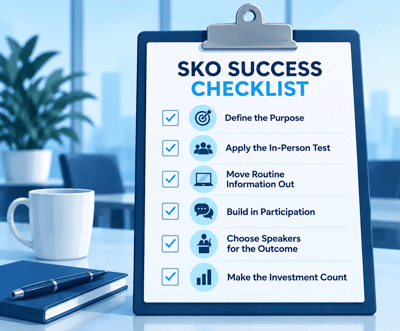 Design the SKO around what is uniquely valuable about being together. Decide what success looks like before building the agenda. Move routine information somewhere else. Give people opportunities to participate rather than simply listen. And do not confuse a strong three-day experience with lasting impact. The SKO should create the clarity, capability, and momentum the sales organization will continue building on after everyone returns to the field.”
Because if most of the agenda could have happened on Zoom, it probably should have.
Planning your next sales kickoff? Funnel Clarity helps sales leaders define what their SKO should accomplish, identify the sales behaviors worth addressing, and build the kickoff around outcomes that last after everyone goes home.