Start With a Free Sales Funnel Consultation


When buyers hesitate, many sales teams assume the problem is resistance. The prospect is being cautious. The buyer is pushing back. The customer is looking for a better price. But hesitation often has a different cause.
In many deals, hesitation forms long before an objection is spoken. Buyers are not reacting to what the seller said in the moment. They are typically reacting to something missing in how they understand the solution, the vendor, or the decision they are about to make.
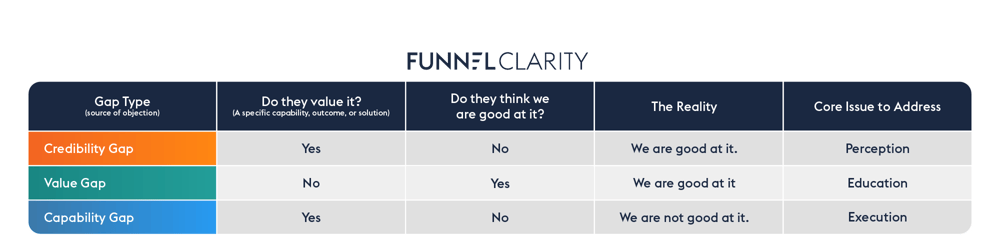
That hesitation usually comes from one of three gaps: a credibility gap, a value gap, or a capability gap.
Understanding which gap exists is far more useful than trying to craft the perfect response to an objection.
Sales teams tend to interpret hesitation as something they need to overcome.
A buyer asks more questions about price.
A stakeholder raises concerns about implementation.
Procurement pushes harder than expected.
The instinct is to respond with persuasion. But persuasion is rarely the right tool when the underlying issue has not been diagnosed correctly.
In reality, buyers hesitate when something important about the decision does not make sense yet. Until that gap is addressed, no amount of selling pressure will move the deal forward.
That is why strong sales organizations teach sellers to diagnose the type of gap they are facing before deciding how to respond.
A credibility gap appears when buyers believe something is important, but they are not convinced the seller can deliver it.
This is not skepticism about the criterion. It's skepticism about the vendor.
The buyer may be asking questions such as:
Can this company actually do what they claim?
Have they solved this problem before?
Will they perform the way they promise once the contract is signed?
When credibility is the issue, the core problem is not persuasion. The problem is proof.
Buyers close credibility gaps through evidence, not persuasion. They need proof that your organization can deliver the outcome they care about.
That proof can come from several sources:
The objective is not to argue that the buyer is wrong. The objective is to make it easier for the buyer to believe. When the credibility gap closes, hesitation often disappears because the buyer’s perception of risk changes.
A value gap appears when the seller’s solution provides something important, but the buyer does not yet see why it matters. In these situations, the seller is often explaining capabilities while the buyer is still trying to understand the problem.
The buyer may be thinking:
Is this really necessary?
Is the improvement meaningful enough to justify change?
Will this make a measurable difference for our business?
When this gap exists, more features will not solve it. The seller must return to discovery.
Closing a value gap requires a deeper understanding of the buyer’s situation. Look for answers on:
These questions shift the conversation away from product explanation and back toward the decision the buyer is trying to make. When sellers understand the buyer’s objectives clearly, they can connect the solution to outcomes the buyer already cares about and helps the buyer see its importance.
A capability gap appears when buyers value something and believe you do not provide it or do it well and they are correct. In this situation, the issue is not persuasion. The issue is fit.
The buyer may be asking questions such as:
Does this solution integrate with our existing environment?
Can this vendor support the scale we require?
Do they have experience in our industry?
When those concerns reflect a real limitation, the seller cannot close the gap with proof or deeper discovery.
When a capability gap is real, sellers must decide whether the opportunity is still worth pursuing.
In some cases, the seller can reposition the discussion around outcomes the organization can deliver. This means helping the buyers reconsider how success should be evaluated and what matters most in the decision.
But if the missing capability is central to the buyer’s requirements, the correct response is to consider no longer pursuing the deal. Continuing to chase opportunities where a real capability gap exists creates long sales cycles, unreliable forecasts, and implementation problems later.
Strong sales organizations recognize that qualifying out of the wrong opportunity protects the pipeline and preserves credibility.
Once sales teams learn to identify these three gaps, their responses change dramatically.
A credibility gap calls for proof.
A value gap requires customer discovery.
A capability gap demands either influence or the discipline to qualify out.
Without this diagnosis, sellers treat every hesitation as resistance and every objection as something to overcome.
With it, they begin to guide buyers through decisions instead of arguing their way through objections.
The three-gap framework is just one example of how many objections originate long before buyers voice them. Most objections appear when the selling process skips the information buyers need to make a confident decision.
Our guide, Most Sales Objections Should Never Happen, explains how sales leaders can redesign qualification, coaching, and deal reviews to prevent objections before they surface.